

Are you wondering whether you need a notarized, regular, or certified translation for immigration to Canada? Getting the translation of documents right from the start for Canadian immigration can make the difference between a smooth application and a frustrating delay.
Submitting an application to Immigration, Refugees and Citizenship Canada (IRCC) is daunting, especially if you don’t know what documents need translation and how certified translation works!
If you’re applying for immigration, permanent residency (PR), a study permit, or a work visa in Canada, and your documents are not in English or French, then getting certified translation services for immigration is an essential step to take.
Immigration, Refugees and Citizenship Canada (IRCC) has strict requirements for how foreign-language documents must be translated. Actually, IRCC document translation requirements must be met; otherwise, it will delay your application or even lead to rejection.
To prevent all that, this article breaks down:
- Which documents usually need an immigration-certified translation
- What a certified translation means in Canada
- Who can translate documents for immigration to Canada, and how to find a translator for Canadian immigration
- How to avoid mistakes that can cost you time and money
- How certified translation services can help with the process
But if you’d like to cut to the chase, you can rely on our certified translation services to meet these requirements today, without any hassle.
Now, without further ado, let’s get to it!
What Is Certified Translation for Immigration to Canada?
In Canada, a certified translation is:
- A translation completed and signed by a translator certified by an official provincial body (such as ATIO or STIBC),
- Or a translation done by a non-certified translator, featuring a sworn affidavit before a notary public.
By a certified translation for immigration to Canada, we mean an official declaration that the translation is complete and accurate, either prepared by a certified translator or accompanied by notarization.
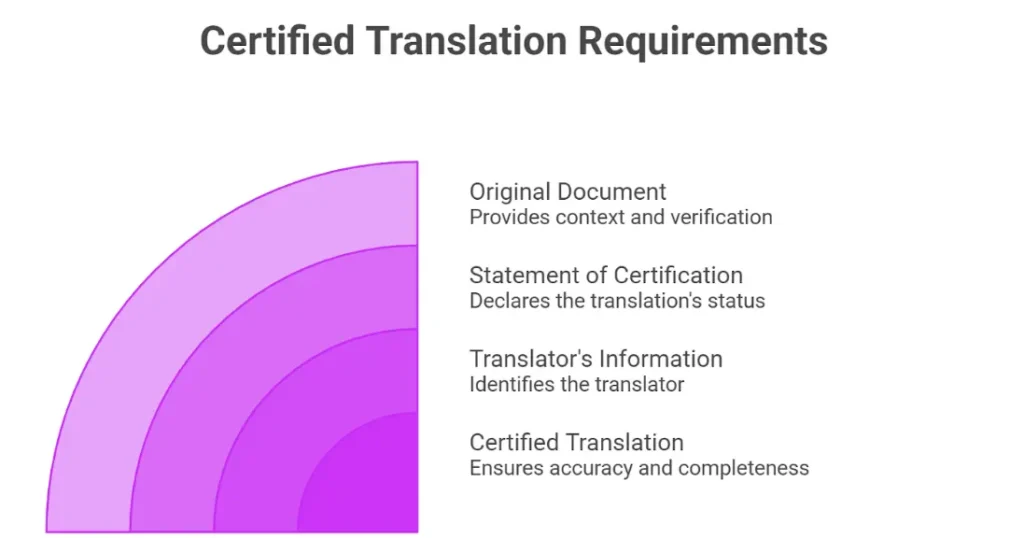
No matter the type, certified translation services for immigration to Canada must meet the strict IRCC translation requirements and standards. They go through testing, credential verification, and ongoing professional oversight. That’s why certified translations must:
- Be accurate and complete
- Include the translator’s name, signature, and certification number or a sworn affidavit
- Clearly state that the document is a certified translation
- Be accompanied by the original document or a copy
❗ IRCC will not accept translations from non-certified translators or from the applicant themselves.
Every compliant certified translation of an immigration document is delivered together with a signed certificate of translation, also called a certificate of accuracy. Indeed, this certificate lists the translator’s credentials and contact details and includes a sworn statement that the translation is complete and correct.
Without it, even a perfectly accurate translation is not considered certified, and IRCC can reject it on that basis alone.
Each of these elements serves a purpose. Accuracy ensures no information is added or removed. Completeness ensures stamps, handwritten notes, and marginal text are included. The translator’s credentials or the notarization allows IRCC to verify that the work was done with maximum accuracy.
Note that IRCC will not accept translations from the applicant themselves or their bilingual friends, family members, teachers, or colleagues. Even professional translators without Canadian certification or notarization are often rejected.
Depending on where you or your translator is based, the certifying body may differ:
- ATIA in Alberta or another association recognized by the Canadian Translators
- Terminologists and Interpreters Council (CTTIC)
- STIBC in British Columbia
- OTTIAQ in Quebec
- ATIO in Ontario
Whichever province issues the credential, IRCC expects the same certification format and the same signed statement of accuracy.
Documents Requiring Certified Translation for Immigration to Canada
Here’s a list of the most common documents that need to be translated for immigration purposes, if they’re not already in English or French:
- Birth Certificates
- Marriage Certificates / Divorce Decrees
- Police Clearance Certificates (Background Checks)
- Diplomas, Transcripts, Degrees
- Medical Records
- Passports (non-English pages)
- National ID Cards or Driver’s Licenses
- Court or Legal Documents
- Employment Letters or Job Contracts
- Adoption Papers or Custody Agreements
Even if the document is partially in English or French, IRCC usually requires a full certified translation of the entire document.
Certified translation of medical records and other personal documents helps IRCC confirm who you are, where you come from, and whether you meet eligibility requirements. Because of this, they are treated as official records.
Of course, documents for Canadian certified translation are not limited to what is listed above. Any supporting document that is not in English or French may need to be translated, depending on the immigration stream and the officer reviewing your file.
Even if the document is partially in English or French, IRCC usually requires a full certified translation of the entire document. This includes stamps, seals, handwritten notes, and annotations. Leaving out small sections can raise questions or lead to a request for resubmission.
Certified translation services for immigration are designed to handle these details carefully. A qualified translator knows what must be included and how IRCC expects it to appear.
If a driver’s license is the only document you need translated, the requirements are still just as strict. See our dedicated guide on certified translation of your driver’s license for Canada for the ATIO-specific rules that apply.
Canada Immigration Document Translation Formats
Certified translations can be digital (PDF) or physical copies, depending on the type of application.
Most immigration applications today are submitted online. In these cases, IRCC typically requires clear scans of the original document along with the immigration certified translation PDF. Both documents should be legible and properly aligned; poor scans, cropped pages, or missing sections can result in delays.
Whether you have to submit a certified translation of academic documents or your personal data, one thing to remember is to never alter the formatting or combine documents unless directed. Applicants sometimes try to merge documents or adjust layouts to save space, which can cause confusion during review. Bear in mind that each document should remain separate and clearly labelled.
It’s best to check directly with IRCC or your immigration consultant to confirm submission guidelines, but your translator should also know how to format everything correctly.
✅ Tip: A single rejected document can delay your entire application by several weeks or even months.
How to Find a Translator for Canadian Immigration
Knowing who can translate documents for immigration to Canada is only half the equation; the other half is knowing how to find a translator for Canadian immigration you can actually trust. Here’s what to check before you hire anyone:
- Confirm they’re a member in good standing of a recognized provincial body, such as ATIO, STIBC, OTTIAQ, ATIA, or CTTIC.
- Ask for their certification number and verify it directly on the association’s public directory.
- Make sure they can issue a proper certificate of translation, not just a translated document.
- Avoid freelancers or platforms that promise cheap, fast turnarounds but can’t confirm Canadian certification.
- If your translator works from outside Canada, confirm they can provide a sworn affidavit signed before a recognized local official.
Working with an established provider like Certified Translations Canada removes the guesswork: every translator on our team is ATIO- or STIBC-certified, so you never have to verify credentials on your own.
Certified Translation Requirements Inside vs Outside Canada
The core requirement is consistent: a complete translation with a certification statement. Inside Canada, this is provided by ATIO- or STIBC-certified translation services, as well as non-certified translation with an affidavit.
Outside Canada, any translator can complete the work as long as they provide a sworn affidavit. This affidavit confirms their competency and the translation’s accuracy. It must be signed before an authorized local official. But generally, the IRCC’s rules focus on the format, not your geographic location.
In all cases, the translator must be independent; they cannot be the applicant, a family member, or a sponsored family member. Using professional certified translation services for immigration ensures these rules are met.
Certified Translation for Visa Applications
If you need to translate documents for a visa application, a study permit, a work permit, or a visitor visa, the same certification rules apply as for permanent residence files. IRCC reviews visa supporting documents with the same scrutiny as PR applications, so a translation error or a missing certificate can cause the same delays.
Documents that most commonly need certified immigration translation for a visa application include:
- Bank and financial statements
- Invitation or sponsorship letters
- Marriage or birth certificates
- Employment or study confirmation letters
For the full breakdown of what typically needs translation across immigration streams, see our guide on ‘which documents require certified translation for immigration.’
Common Mistakes to Avoid When Getting Certified Translation for Immigration to Canada
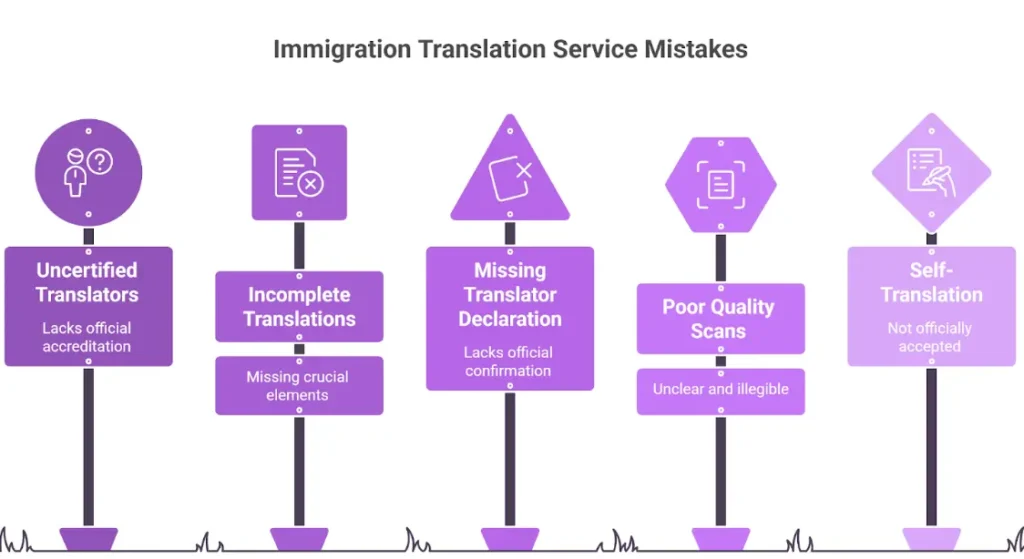
Canadian authorities are very strict on immigration certified translations and how they are submitted. Still, many applicants fall into a common set of pitfalls in their immigration process. The most common mistakes that can delay the immigration process include:
- Using uncertified translators (e.g., family friends, freelancers without accreditation)
- Submitting incomplete translations (missing pages, stamps, signatures)
- Omitting the translator’s declaration and signature or the affidavit
- Submitting poor-quality scans or unclear copies
- Self-translating your own documents.
Especially when it comes to certified translation of financial documents and other personal records, these mistakes are common because applicants often focus on speed or cost. Unfortunately, cutting corners with translation often leads to longer processing times and higher overall costs.
Some applicants rely on online platforms that promise fast and cheap translations. While the language itself may be accurate, the lack of certification makes the document unusable for immigration. Even a single rejected document can delay your entire application by several weeks or even months, which, in competitive immigration programs, can result in missing intake caps or losing eligibility.
The scale of IRCC’s workload makes this even riskier. Between January and October 2024 alone, IRCC finalized close to 5.93 million applications for:
- Permanent residence
- Temporary residence
- and citizenship combined
The program aims to process 80% of files within the published service standards. With that volume moving through the system, officers have little time to chase down a missing certificate or an incomplete translation; an incomplete file is simply set aside until it is fixed.
Why You Should Use Certified Translation Services for Immigration
Given IRCC’s strict requirements and accuracy standards, it’s critical to rely on professional services that provide properly certified translations. To prevent delays or rejection risks, Certified Translations Canada provides certified translation services done by ATIO- and STIBC-certified translators, as well as notarization services.
In every translation, we ensure linguistic accuracy and full compliance with IRCC standards. In British Columbia, STIBC and in Ontario, ATIO, certified translation services are available to give you:
- Peace of mind that your translation is fully compliant
- Full acceptance by IRCC, legal, academic, and government bodies
- Documentation that includes all the proper formats, stamps, and translator credentials
Our team of certified translators are bound by professional standards and accountability, and their work is recognized across Canada.
Our rush services also make sure your documents are translated and certified on your timeline, meeting all the standards! To ensure your translated documents are properly certified, fulfilling IRCC standards on the first try, don’t hesitate to upload your documents today and get a free quote!
Real Case Example of Why ATIO Certified Translations Matter
We recently had a client who submitted a translation done by a freelancer on an online platform. The translation looked accurate, but it lacked a proper certification. IRCC rejected the application and requested a new translation, causing a 6-week delay.
This situation is far more common than most applicants realize. IRCC does not provide detailed feedback on translation quality. It simply states that the document does not meet requirements.
Once the client came to us, we issued an ATIO-certified translation for immigration to Canada. Although there were minimal changes to the content (the only difference being the certification), it was accepted immediately.
This happens more often than you think. That’s why it’s critical to get professional ATIO-certified translation services for immigration.
How Long Does Certified Translation for Immigration Take?
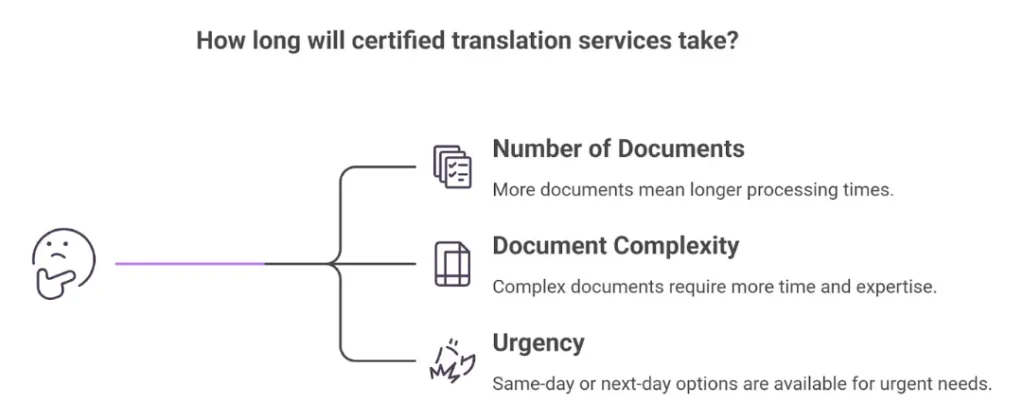
Immigration certified translations are usually delivered in 1 to 3 business days, depending on:
- Number of documents
- Document complexity
- Urgency (same-day or next-day options are often available)
Translation of a driver’s license and other simple documents is usually faster. Business certified translations, on the other hand, may take longer due to formatting and terminology.
With Certified Translations Canada, rush options are possible if you’re on a tight deadline. Just upload your documents, and we’ll make sure they’re ready for submission in one business day, even during peak immigration seasons!
Ready to Get Started?
Certified translation for immigration to Canada requires working with the right professional to ensure your documents meet IRCC requirements from the get-go. Our certified translation services for immigration are fast, reliable, and available for urgent cases.
Our experience spans all common immigration documents. This way, we’ll ensure accurate handling of sensitive personal information, from dates and names to specialized legal or academic terms. Don’t hesitate to keep in touch with Certified Translations Canada for more details!
FAQ on Certified Translation for Immigration Canada
Here are the most common questions you have about certified translation for immigration in Canada:
1- What is the difference between certified translation and official translation?
In Canada, these terms are often used interchangeably. Official or certified translation means a translator certified by a provincial association, like ATIO, has translated and stamped the document.
2- How Much Does It Cost to Translate Official Documents?
Costs vary by document type and language. Standard documents like birth certificates often have a fixed, reasonable fee.
3- How to Make a Certified Translation of a Document?
You cannot “make” one yourself. You must hire a certified translator. They translate, then provide a signed statement of accuracy with their seal.
4- How to Get Certified Translated Documents Online?
You can safely use a professional service like Certified Translations Canada. Upload your documents, and we handle the certified translation and return them digitally or by mail.
5- How to Find a Certified Translator?
Search for members of provincial associations like ATIO. For a reliable service, choose Certified Translation Canada. Our translators are fully certified and experienced.
6- Which Translator Is Accepted by IRCC?
IRCC accepts translations from translators certified in Canada. This includes members of provincial bodies like ATIO, STIBC, or CTTIC.
7- How Do You Know if a Translator Is Certified?
Ask for their certification number. You can then verify their membership online with their provincial association, such as ATIO’s public directory.
8- What Is the Translation Fee for Certified Translation for Immigration to Canada?
Fees depend on the document. For a clear quote on your certified translation for immigration to Canada, send us the documents. Within one hour, you’ll receive the quote with no hidden costs.
9- Can I Do a Certified Translation Myself?
No. IRCC explicitly does not accept translations done by the applicant or their family, even if they are fluent. It must be done by an independent certified professional.
10- What Is the Difference between a Certified Translation and a Notarized Translation?
A certified translation is done by a certified translator. A notarized translation is done by a non-certified translator, then a notary public stamps the translator’s affidavit.
11- How Can I Translate Documents for a Visa?
For a Canadian study permit, work permit, or visitor visa, you need the same certified translation immigration applicants use for permanent residence files. Send your documents to a certified provider, and we’ll make sure they meet visa and IRCC requirements, the same standard used across every immigration stream.
12- What Do People Mean by “Certified Translation Immigration Canada”?
It’s simply another way people search for Canada immigration certified translation: a translation certified by a provincial body like ATIO or STIBC, or notarized by a notary public, and accepted by IRCC. Whichever term you use, the certification requirements stay the same.
13- What Are IRCC’s Translation Requirements?
IRCC requires every translated document to be complete, word-for-word accurate, and submitted alongside the original document or a copy. The translation must include the translator’s name, signature, and certification number, or a sworn affidavit if the translator isn’t certified. It must also come with a signed certificate of translation.
Missing any one of these pieces is treated the same as submitting no translation at all.
14- Is There an Official IRCC Certified Translator List?
IRCC itself does not maintain a certified translator list. Instead, it recognizes translators who are members in good standing of a provincial regulatory body, such as ATIO, STIBC, OTTIAQ, CTTIC, or ATIA.
Each association publishes its own public directory, which is the closest thing to an “IRCC-approved” list and the best place to verify a translator’s credentials before you hire them.